Picture
Will the U.S. be overrun by disease-causing "superbugs" that are resistant to just about every antibiotic?

It's possible, some scientists say.

Recently, three Americans were treated for serious urinary tract infections caused by bacteria carrying a gene that makes them highly resistant to antibiotics.

Bacteria that carry the gene, known as New Delhi metallo-beta-lactamase (NDM-1), are widespread in India, and each of the three Americans had recently spent time there.

One of the Americans sickened by the superbug was treated at Massachusetts General Hospital in Boston. A woman with the superbug was treated in California, and a man with it was treated in Illinois.

All three survived, but not everyone is so lucky.


Link to source: http://bit.ly/dmi0lg
 
 
Picture
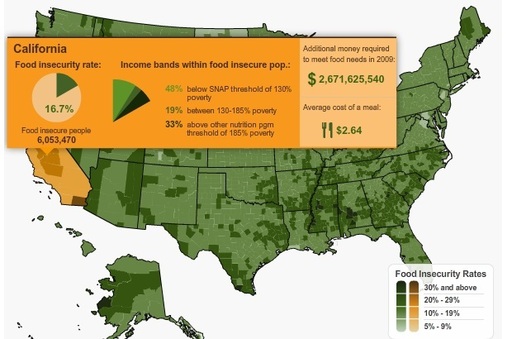
More than 1.7 million Los Angeles County residents struggled with hunger in 2009, more than in any other county in America, according to new research published by Feeding America, the country’s largest network of food banks.

The study, called Map the Meal Gap, uses statistics collected by the U.S. Department of Agriculture, Census Bureau and other agencies to profile food insecurity across America.

“It’s hard to imagine in a nation that grows much of the world’s food that people cannot always afford to feed themselves or their kids,” said Vicki Escarra, Feeding America’s president and chief executive.

“But the fact is that domestic hunger is a serious problem.”

The study found that there are people in every county who at times can’t provide enough food for an active and healthy life for every household member -- the USDA measure for food insecurity. Rates ranged from 5% in Steel County, S.D. to 38% in Wilcox County, Ala.

At nearly 17%, the rate in Los Angeles was about the same as the national average. But in nearby Imperial County, it climbed to more than 31%.

“Hunger is closer than one might think,” Escarra said at a news conference Thursday in Washington, D.C., to announce the findings.

Matthew Sharp, a senior advocate with California Food Policy Advocates, attributed the high number of food insecure Angelenos to “the extraordinary cost of living and low wages.” Unemployment remains high in California and those returning to the workforce often find that they can’t get the hours or salaries they need.

The study found that many of those at risk of hunger don’t qualify for federal nutrition benefits, including about a third of the more than 6 million food insecure Californians in 2009, the most recent year for which data is available.

More than half of these Californians did not meet the income requirements for food stamps -- known locally as CalFresh -- and an estimated 33% did not qualify for other programs such as free or reduced-price school meals. Eligibility for these programs is linked to the federal poverty level, which advocates of low-income families have long argued is a poor measure of what it takes to make ends meet.

To qualify for food stamps, for example, households cannot earn more than 130% of the poverty level. That was $28,655 a year for a family of four in 2009, the most recent year for which food insecurity data is available. The maximum threshold for most other nutrition programs is 185% of the poverty level, then $40,793 a year for a family of four.

Previous studies only provided state-level food insecurity estimates, which researchers said were too broad to help local organizations address the need in their communities.

In counties like Imperial, Kern and Tulare, the study found that more than 60% of those at risk of hunger could be eligible for food stamps. Such areas might benefit from more outreach about federal nutrition programs, the study said.

While the food stamp rolls have been increasing in California, participation in the program has been among the lowest in the nation. Just half of the eligible Californians received the benefit in 2008, the most recent year for which federal estimates are available.

In counties with a higher proportion of food insecure people who are not eligible for government assistance, the burden to help often falls on family members and local charities.

The number of people fed by the Los Angeles Regional Food Bank increased from about 674,000 in 2006 to more than 1 million last year, said the group’s president and chief executive, Michael Flood. 

Although the food bank has been able to increase the volume of food it provides to food pantries, soup kitchens and other programs, supply has not kept pace with demand. Some have had to turn people away empty-handed, Flood said.

Link to source: http://lat.ms/fIlOIo
 
 
German exchange buying New York Stock Exchange.

On the face of it, a German company is buying an icon of American capitalism.

The reality of Deutsche Boerse AG’s proposed acquisition of the New York Stock Exchange is more complex.

For one thing, two of Deutsche Boerse’s largest shareholders are American.

Also, the parent company of the New York Stock Exchange isn’t entirely American. NYSE Euronext Inc. was formed in a merger between the NYSE and a group of European exchanges in 2007. Euronext itself was created in 2000 from the combination of stock markets in Paris, Brussels and Amsterdam.

The proposed merger of Deutsche Boerse and NYSE Euronext, announced Tuesday, would create a worldwide owner of financial markets that would be incorporated in the Netherlands. The new company would have dual headquarters in New York and Frankfurt.

CME Group Inc., owner of the Chicago Mercantile Exchange and the Chicago Board of Trade, held Tuesday to its “no comment” stance about reports that it might submit a competing offer.

NYSE Euronext is already global. U.S. stock and derivatives trading contribute only 14.4 percent of its revenue, while 34.6 percent comes from European trading. Similarly, Deutsche Boerse owns the American options exchange International Securities Exchange. Five of its 10 largest shareholders are American, according to FactSet.